

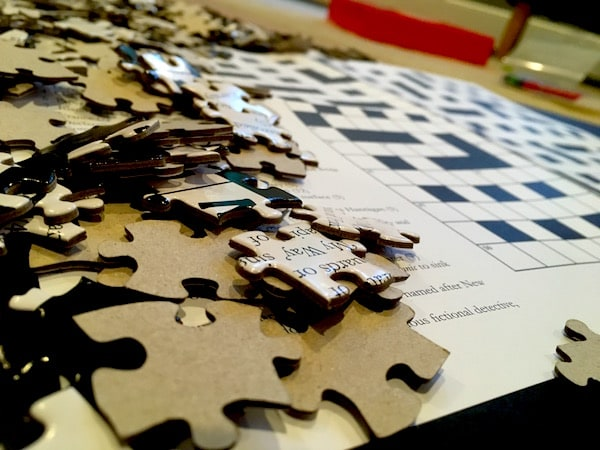
The traditional image of a medical student involves a weary scholar buried under mountains of textbooks, memorizing endless lists of symptoms and drug interactions. However, a recent study published in the Journal of Education and Health Promotion (2025) suggests that the future of medical training might look a lot more like game night.
The research, titled “Connecting the pieces: Exploring the use of jigsaw puzzles in medical education,” provides strong evidence that gamification—specifically the use of physical and mental puzzles—can outperform traditional study methods in both immediate learning and long-term retention.
The Research: Solving the Psychiatry Puzzle
Psychiatry is notoriously difficult to teach via standard lectures because diagnostic criteria are often abstract and subjective. The study, led by Mahya Mojahedi at Birjand University of Medical Sciences, recognized that students often struggle to “see the whole picture” when reading the Diagnostic and Statistical Manual of Mental Disorders (DSM-5).
To bridge this gap, the researchers conducted a quasi-experimental study with 63 medical students. Instead of a standard lecture on anxiety disorders, students were given 50-piece jigsaw puzzles where the pieces contained the diagnostic criteria for Panic Attack, Generalized Anxiety, and Social Anxiety.
The results were striking:
- Immediate Mastery: Test scores jumped significantly from an average of 26 (pre-test) to 9.65 (post-test).
- Long-Term Retention: 20 days later, students retained almost all the information, with follow-up scores averaging 98.
- Student Satisfaction: On a scale of 22–66, students reported a satisfaction level of 61, describing the process as engaging and helpful for reducing the stress of complex subjects.
The study concluded that the “visuospatial association” created by puzzles helps the brain create mental connections that traditional reading simply cannot match.
Expanding the Toolbox: Crosswords and Active Recall
While the Mojahedi study focused on jigsaws, the authors highlighted that other puzzles, such as crosswords, are equally effective—especially for learning terminology and definitions. Unlike passive reading, crosswords require “active recall,” forcing the student to retrieve information from memory based on a clinical clue.
Research cited in the study shows that crosswords are particularly popular in Pharmacology and Microbiology, where precise nomenclature is critical. By turning a list of medications into a word game, educators can move students from rote memorization to active problem-solving.
Digital Tools for the Modern Educator
One of the biggest hurdles for medical professors has historically been the time required to create these games. However, the study and current educational trends highlight how accessible these tools have become through digital platforms.
1. For Jigsaw Creation
In the original research, the team used puzzlesnap. This tool allowed them to upload images of DSM-5 text, set a difficulty level, and create custom puzzles that could be printed on foam backing for a tactile classroom experience.
2. For Crosswords and Word Games
For educators looking to reinforce medical terminology, several platforms have become “go-to” resources:
- guru: A helpful starting point for finding answers to medical puzzles. The site allows you to bridge the gap between general knowledge and the specialized lexicon of healthcare
- EclipseCrossword: A classic desktop tool for creating high-complexity medical crosswords for print or web.
- Crossword Labs: A simple, no-frills site for creating and sharing puzzles instantly without an account.
- Wordwall: Often used for medical “escape rooms,” this site allows teachers to turn one set of vocabulary words into various games, including crosswords, “whack-a-mole,” and anagrams.
Conclusion: A “Serious” Case for Fun
The findings from the Journal of Education and Health Promotion make one thing clear: serious subjects do not require dry teaching methods. By integrating the tactile logic of a jigsaw puzzle or the mental challenge of a crossword, educators can create doctors who are not only better at memorizing data but better at “connecting the pieces” to see the whole patient.
As the study concludes, moving away from teacher-centered lectures toward active, puzzle-based learning creates a more immersive experience that is “effective, engaging, and enjoyable.”